

Data Centre Infrastructure in India is becoming increasingly important as the country’s digital economy continues to expand at a rapid pace. From digital payments and cloud platforms to artificial intelligence, e-commerce, online education, and enterprise applications, an increasing number of services depend on reliable computing and storage infrastructure.
Behind this digital growth are data centres that operate continuously to store, process, and manage massive volumes of information. As businesses and consumers become more dependent on digital services, the demand for secure, scalable, and reliable data Centre infrastructure in India is also growing.
As businesses and consumers become more dependent on digital services, data centre infrastructure in India is becoming an increasingly important part of the country’s economic and technological development.
The Growing Importance of Data Centres in India
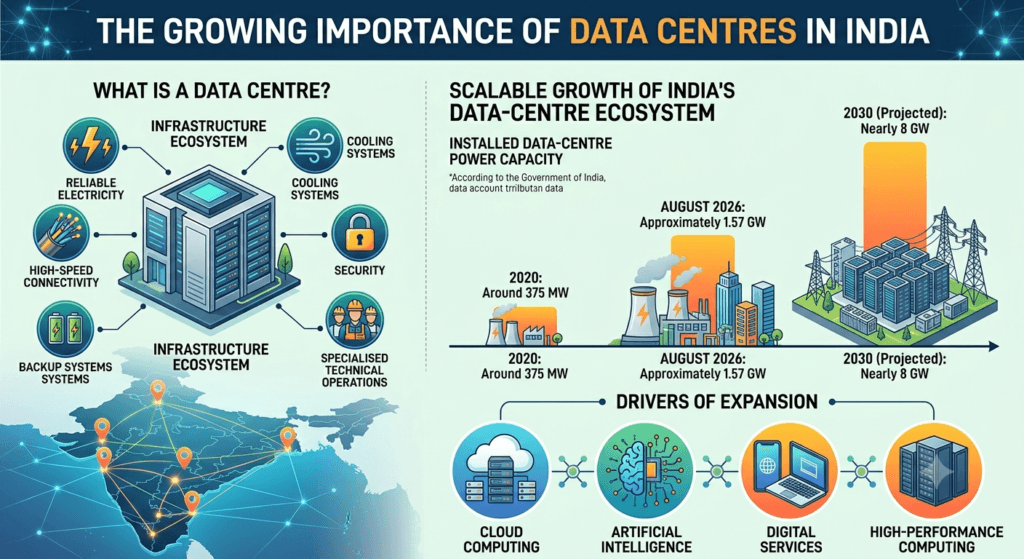
A data centre is more than a facility filled with servers. It is a critical infrastructure ecosystem that requires reliable electricity, high-speed connectivity, cooling systems, security, backup systems, and specialised technical operations.
The scale of India’s data-centre ecosystem has grown considerably. According to the Government of India, installed data-centre power capacity increased from around 375 MW in 2020 to approximately 1.57 GW by August 2026. The government has also noted that capacity could expand further to nearly 8 GW by 2030.
This expansion reflects the increasing demand created by cloud computing, artificial intelligence, digital services, and high-performance computing.
The Growing Importance of Data Centres Infrastructure in India
A data centre is more than a facility filled with servers. It is a critical infrastructure ecosystem that requires reliable electricity, high-speed connectivity, cooling systems, security, backup systems, and specialised technical operations.
The scale of India’s data-centre ecosystem has grown considerably. According to the Government of India, installed data-centre power capacity increased from around 375 MW in 2020 to approximately 1.57 GW by August 2026. The government has also noted that capacity could expand further to nearly 8 GW by 2030.
This expansion reflects the increasing demand created by cloud computing, artificial intelligence, digital services, and high-performance computing.
What Is Driving Data Centre Development in India?
Several factors are contributing to the growth of data centre development in India.
1. Rapid Digitalisation
Businesses across industries are moving more operations online. Banking, retail, healthcare, education, entertainment, logistics, and government services all require dependable digital infrastructure.
As digital transactions and online platforms increase, the need for secure and scalable data storage and processing also grows.
2. Artificial Intelligence and Cloud Computing
AI applications require substantial computing power. Training and operating advanced AI systems can involve large volumes of data and high-performance computing infrastructure.
At the same time, companies are increasingly using cloud platforms instead of maintaining all their IT infrastructure internally. This is creating additional demand for large-scale data centres.
The Government of India has identified the growth of AI and high-performance computing as important drivers of increasing data-centre capacity.
3. Demand for Reliable Digital Infrastructure
Digital businesses cannot afford prolonged interruptions. Data centres therefore need dependable power, connectivity, cooling, security, and backup systems.
This makes location an important consideration. Access to power infrastructure, fibre connectivity, skilled professionals, transport networks, and major business centres can influence where data-centre projects are developed.
Why Location Matters for Data Centres
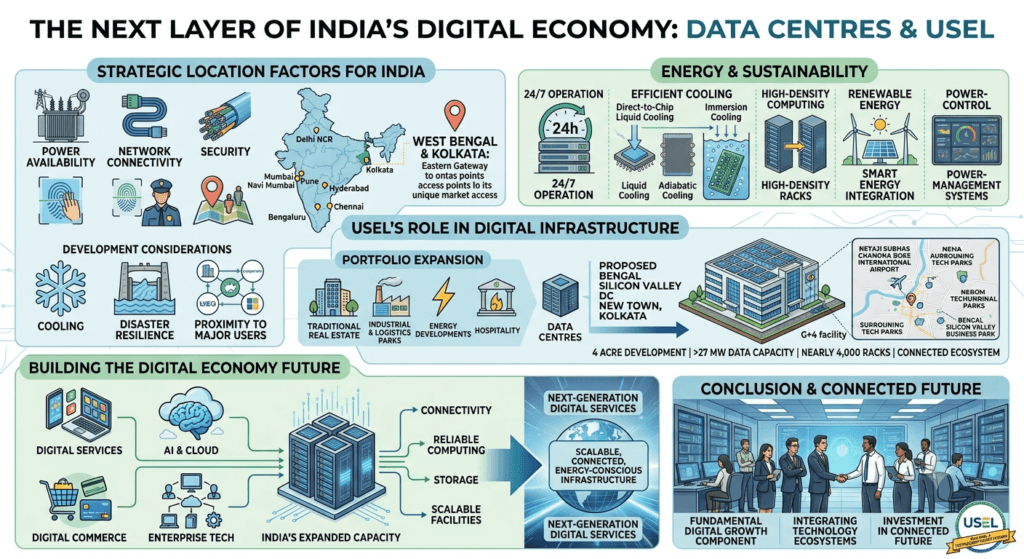
Data-centre development requires more than available land. Developers need to consider power availability, network connectivity, security, cooling requirements, disaster resilience, and proximity to major users.
India’s major data-centre markets include Mumbai, Navi Mumbai, Chennai, Bengaluru, Hyderabad, Delhi NCR, Pune, and Kolkata. Government information also identifies West Bengal as one of the states attracting new data-centre investment.
Kolkata has an additional advantage as a gateway to Eastern and North-Eastern India. Its connectivity, growing technology ecosystem, and access to regional markets create opportunities for digital infrastructure development.
The Role of Energy and Sustainability
Data centres operate around the clock, making energy efficiency a major consideration for the sector.
As data-centre capacity grows, developers are increasingly looking at efficient cooling technologies, high-density computing, renewable energy integration, and better power-management systems.
The Government of India has highlighted technologies such as direct-to-chip liquid cooling, adiabatic cooling, immersion cooling, and high-density racks as approaches being adopted to improve water and energy efficiency.
Therefore, the future of data centre infrastructure in India will not depend only on increasing capacity. Efficient resource management and sustainable operations will also become increasingly important.
USEL’s Role in Digital Infrastructure
Universal Success Enterprises Limited (USEL) has expanded its portfolio beyond traditional real estate into infrastructure, business and IT parks, industrial and logistics developments, energy, hospitality, and data centres. Through these developments, USEL is contributing to the evolving landscape of Data Centre Infrastructure in India and supporting the country’s growing digital economy.
One of its notable digital infrastructure initiatives is the proposed Data Centre in Bengal Silicon Valley Business Park in New Town, Kolkata.
According to USEL, the development spans approximately 4 acres and is planned as a G+4 facility with more than 27 MW of data capacity and nearly 4,000 server racks. Its location near Netaji Subhas Chandra Bose International Airport and surrounding technology and business developments is intended to support connectivity and accessibility.
This type of development demonstrates how Data Centre Infrastructure in India can become part of a broader business ecosystem rather than operating as an isolated facility.
Building the Next Layer of India’s Digital Economy
The expansion of digital services will continue to create demand for reliable computing, storage, and connectivity. As AI, cloud computing, digital commerce, and enterprise technology become more deeply integrated into everyday business, Data Centre Infrastructure in India will play an increasingly important role in supporting the country’s growing digital economy.
For developers, this creates an opportunity to combine technology infrastructure with strategic location planning, reliable utilities, connectivity, and sustainable development practices.
India’s data-centre capacity has already expanded significantly, and government projections indicate further growth in the coming years.
The future of digital infrastructure will therefore depend not simply on building more data centres, but on creating facilities that are scalable, connected, energy-conscious, and capable of supporting the next generation of digital services.
Conclusion
Data centre infrastructure in India is becoming a fundamental component of the country’s digital growth. The expansion of cloud computing, artificial intelligence, digital services, and high-performance computing is creating new requirements for reliable and scalable infrastructure.
With its presence across real estate, business parks, logistics, energy, and data-centre development, USEL is positioned within this broader infrastructure landscape. Its Bengal Silicon Valley project in Kolkata represents one example of how digital infrastructure can contribute to the development of a growing technology ecosystem.
As India’s digital economy continues to evolve, investment in modern data centres and supporting infrastructure will remain an important part of building a connected and technology-ready future.

Navigation
Verticals
Contact Info
- #06-01 Sunshine Plaza, 91 Bencoolen Street, Singapore 189652
- +65 6836 3955
- contact@usel.biz