

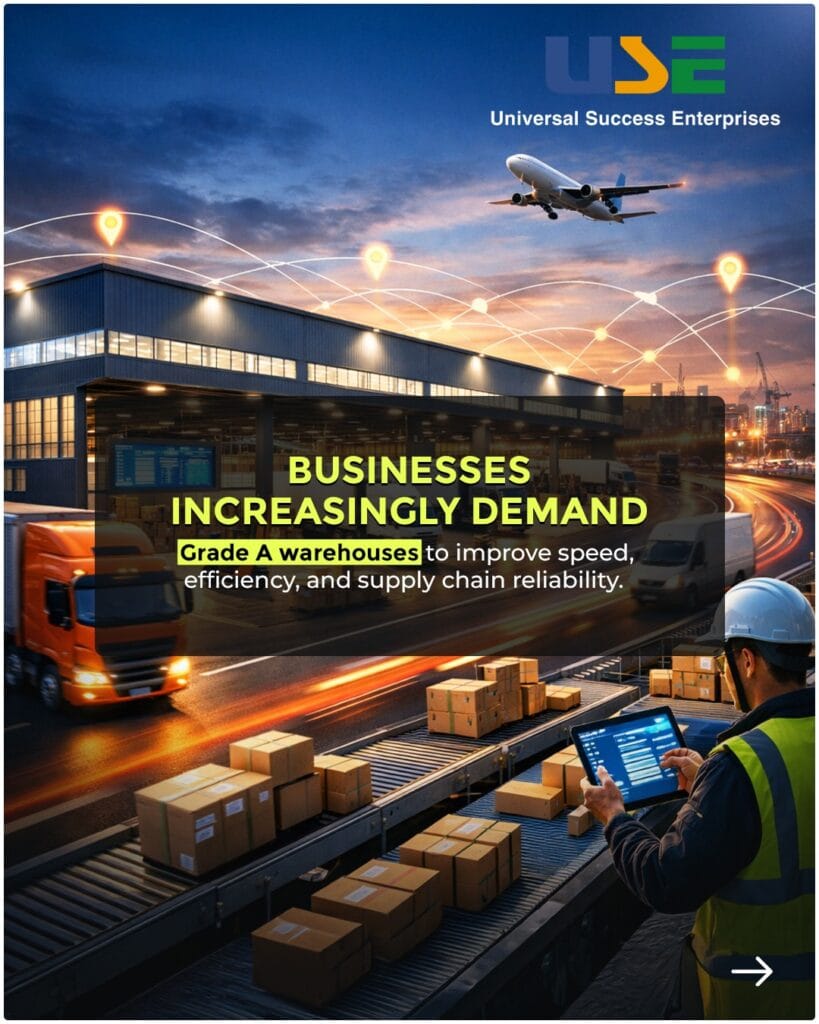
India’s logistics and supply chain ecosystem is undergoing one of the most significant transformations in its history. As businesses compete in an environment defined by speed, efficiency, and reliability, traditional warehousing models are no longer sufficient. The demand is shifting decisively toward Grade A warehouses—facilities designed to meet modern operational standards and technological integration needs.
The Shift from Storage to Strategic Infrastructure
Historically, warehouses were treated as storage units—large spaces where goods were simply kept before distribution. Today, they function as critical nodes within integrated supply chains. With the explosive growth of e-commerce, third-party logistics (3PL), manufacturing expansion, and omnichannel retail, warehouses are no longer passive assets—they are operational command centers.
Grade A warehouses typically offer:
- High floor load capacity
- Large clear ceiling heights
- Advanced fire safety systems
- Dock levellers and multiple loading bays
- Modern security infrastructure
- Technology-enabled inventory systems
These features significantly reduce turnaround time and increase throughput efficiency.
Speed Is the New Currency
In the current market, delivery timelines are a competitive differentiator. Consumers expect same-day or next-day delivery, while businesses require seamless inter-city distribution. Grade A warehouses, strategically located near highways, ports, airports, and consumption hubs, enable faster goods movement and improved last-mile connectivity.
Moreover, integrated digital tracking systems allow real-time monitoring of inventory, reducing stockouts and enhancing forecasting accuracy.
Reliability in a Disrupted World
The pandemic exposed vulnerabilities in global supply chains. Businesses are now prioritising resilience over cost minimisation alone. Modern warehouses are built with scalability in mind—allowing companies to expand operations quickly during demand spikes.
Automation and data-driven logistics planning further enhance reliability, minimising human error and optimising workflow processes.
Sustainability and Compliance
Another key factor driving Grade A adoption is sustainability. Energy-efficient lighting, solar rooftops, rainwater harvesting systems, and compliance with green building norms are increasingly standard expectations.
Investors and corporate stakeholders now evaluate logistics infrastructure through ESG metrics. Modern warehousing aligns operational efficiency with environmental responsibility.
Sustainability as a Core Principle
The Developer Perspective
Forward-looking enterprises are responding to this demand by developing logistics infrastructure that anticipates long-term growth rather than reacting to short-term trends.
Organisations such as Universal Success Enterprises (USEL), which operate across industrial and logistics development, are focusing on future-ready warehouse ecosystems designed to support smarter supply chains.
The Road Ahead
India’s logistics real estate market is projected to continue expanding rapidly, supported by manufacturing growth, policy reforms, and infrastructure upgrades. As supply chains become more complex and customer expectations rise, Grade A warehouses will no longer be optional—they will be essential.
The businesses that prioritise modern warehousing today are the ones building competitive advantage for tomorrow.